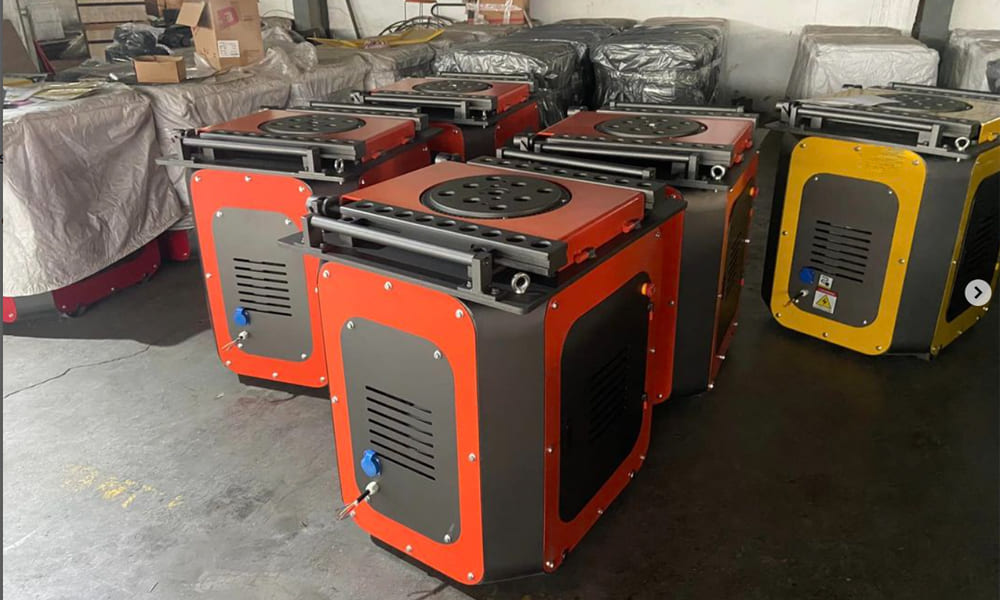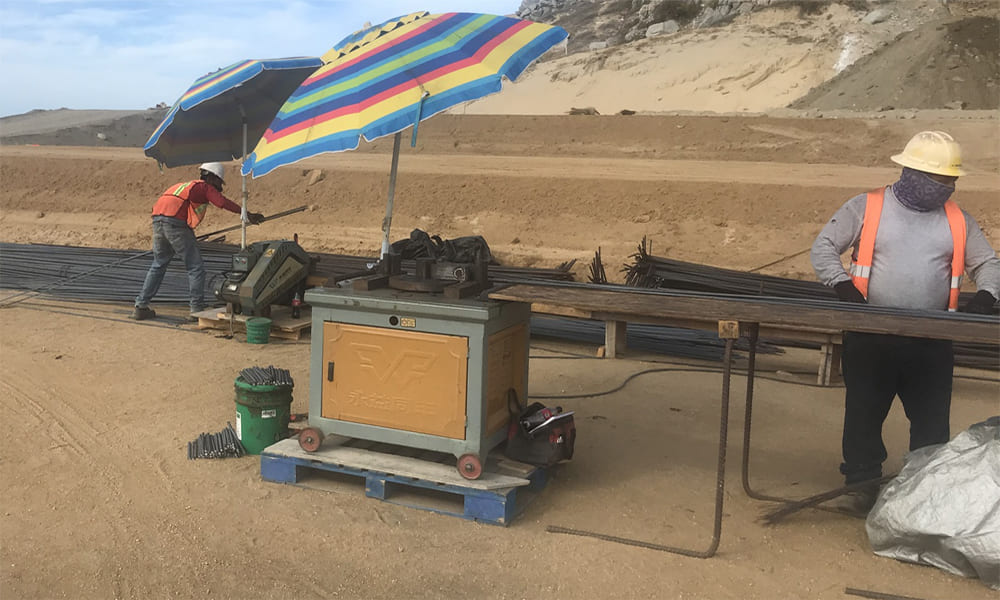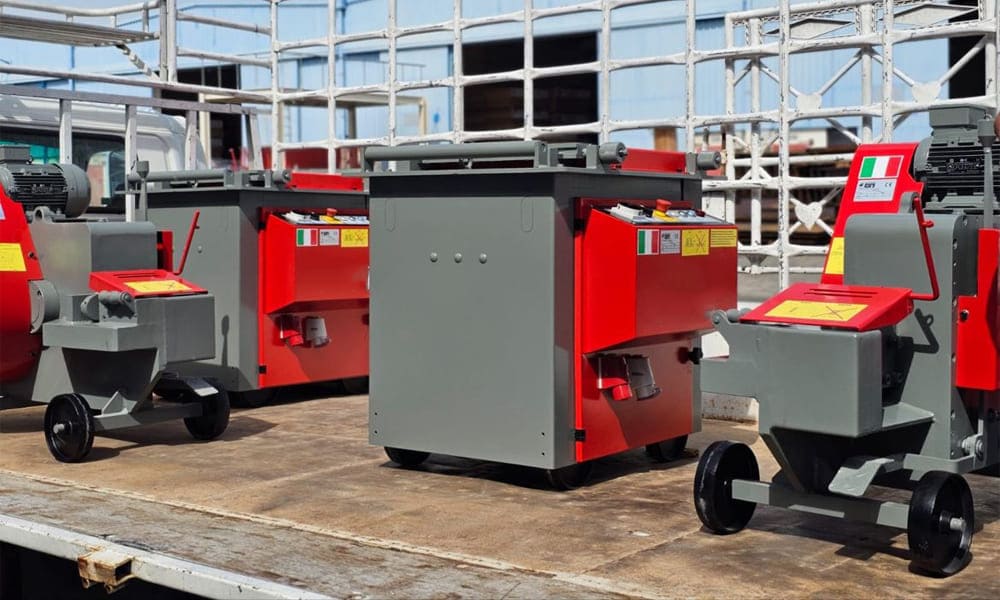
For P52 Rebar Bending Machine, the method of angle control is a fundamental technological consideration, directly influencing both rebar processing quality and on-site operational flexibility. This section provides a detailed comparison between traditional mechanical stops and modern electronic sensing systems, assisting GHM Machinery’s international clients in selecting the optimal configuration based on their practical application needs.
1.1 Mechanical Stop System (Traditional Limit Control)
This conventional approach uses a physical barrier, or stop plate, mounted on the bending mechanism to restrict the rotation of the bending arm. Its operation is purely mechanical: when the arm reaches the preset angle, it contacts the fixed stop, and mechanical resistance halts the motion, thereby setting the bend angle.
Advantages
-
Simplicity & Cost-Effectiveness: Composed of basic components such as stop plates, screws, and brackets, it is inexpensive to manufacture and maintain. This makes it ideal for budget-conscious users and bender models intended for straightforward applications.
-
Robustness & Reliability: Unaffected by electrical fluctuations, temperature variations, or electromagnetic noise. It performs consistently in challenging site conditions—including dust, moisture, and vibration—with a low failure rate and high longevity.
-
Ease of Use & Maintenance: Adjusting the angle requires only manual repositioning and securing of the stop plate, a skill easily acquired. Routine upkeep involves simple cleaning and lubrication, minimizing long-term service complexity and expense.
Disadvantages
-
Limited Precision: Subject to machining tolerances, assembly variances, and wear over time, its accuracy is generally within ±1° to ±2°. This is insufficient for high-precision bending demanded in projects such as bridges or high-rise structures.
-
Inflexible Adjustment: Changing the bend angle necessitates manual alteration of the physical stop, a process that is slow and cumbersome. It does not allow for fine, incremental adjustments, reducing efficiency in jobs requiring frequent angle changes.
-
Lack of Data & Feedback: The system cannot log actual bend angles, production counts, or other metrics, complicating quality tracking and progress monitoring. Angle drift due to wear may go unnoticed, potentially leading to rebar waste and project delays.
1.2 Intelligent Electronic Sensor System
P52 Rebar Bending Machine, This advanced control technology, employed in high-performance benders, uses high-accuracy sensors (e.g., rotary encoders) to continuously monitor the bending arm’s position. The real-time signal is processed by a PLC, which commands the machine to stop precisely when the programmed angle is reached.
Advantages
-
High Accuracy: Sensor-based measurement enables precise control within ±0.1° to ±0.5°, meeting stringent tolerances for specialized reinforcement work. This minimizes processing errors and significantly improves yield rates.
-
Programmable Flexibility: Bend angles can be set and modified instantly via a touchscreen or control panel, supporting unlimited adjustments. Rapid switching between angles boosts productivity, especially for complex or variable bending tasks.
-
Data Intelligence & Monitoring: The system automatically records key production data—including achieved angles, piece counts, and cycle times—enabling straightforward quality traceability and job management. It can also provide real-time alerts for deviations, preventing material waste.
-
Automation Compatibility: Easily integrates with automated feeding, bending, and discharging systems to create a fully automated processing line. This enhances overall equipment automation, reduces labor intensity, and minimizes human error.
Disadvantages
-
Higher Complexity & Cost: The integration of precision sensors, PLCs, and interfaces increases manufacturing expenses, reflected in the machine’s price. Maintenance and repairs also require specialized technical knowledge, raising long-term service costs.
-
Environmental Sensitivity: Electronic components can be vulnerable to extreme conditions such as heavy dust, humidity, temperature swings, and strong electromagnetic interference, potentially affecting reliability in harsh outdoor environments.
-
Increased Operational Skill Requirement: Operators must be trained to use the control interface for angle programming, data access, and basic troubleshooting, incurring additional training investment.
1.3 Selection Summary
The traditional mechanical stop system is well-suited for small to medium-scale sites, budget-sensitive operations, or applications where extreme precision is not critical. Its strengths lie in durability, simplicity, and low total cost of ownership.
The intelligent electronic sensor system is the preferred choice for large-scale, high-standard projects, precision fabrication, or users prioritizing efficiency, repeatability, and digital job management. It delivers superior accuracy and automation readiness, though it requires a greater upfront investment and more skilled operation.
GHM Machinery offers P52 Rebar Bending Machine equipped with either technology, enabling international clients to find the optimal balance between economic value and processing capability to meet the diverse demands of global construction scenarios.