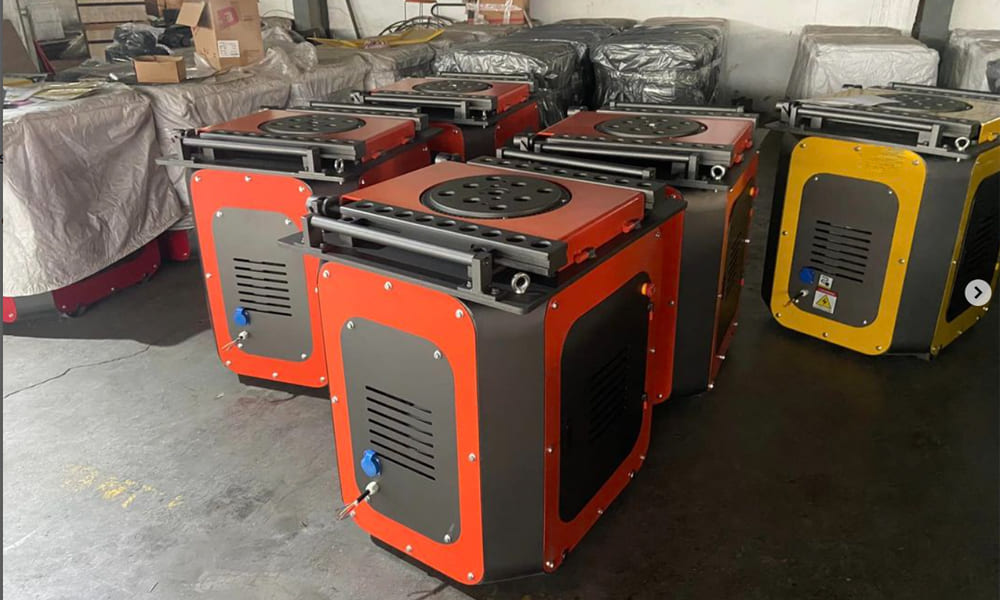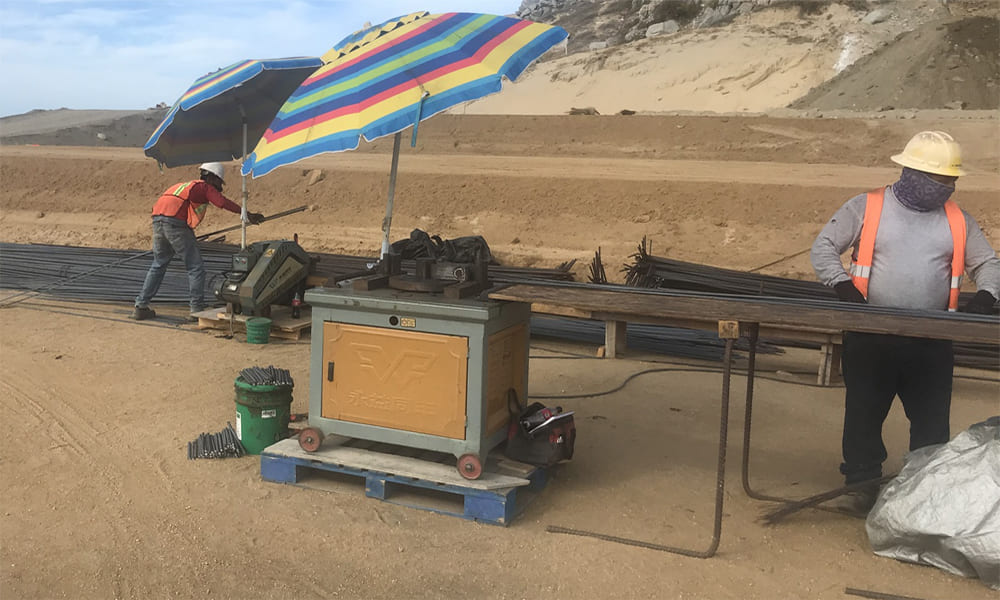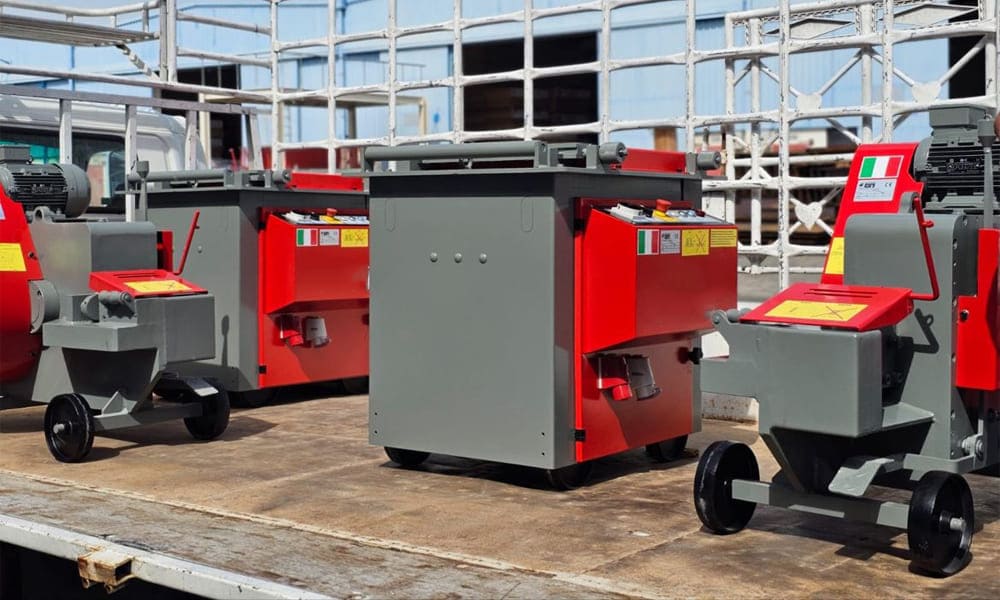
P52 Steel Bar Bender is an essential piece of equipment in rebar processing. Its core function is to utilize mechanical transmission to drive its working mechanism, applying a directed bending moment to steel bars. This enables operators to bend bars into specified angles or shapes—such as stirrups and hooks—as required by construction standards. The equipment is indispensable across various engineering applications, including building construction and bridge work.
I. Fundamental Operating Principles
In essence, P52 Steel Bar Bender operates on the following sequence: a motor provides the initial power, a transmission system modifies speed and torque, a working disc drives tooling to apply force to the bar, resulting in its plastic deformation. The detailed process is as follows:
-
Power Input: Upon activation, the electric motor generates rotational power. This power is transmitted to the reduction gear unit via a coupling.
-
Speed Reduction & Torque Increase: Motors typically operate at high speeds with low torque, which is insufficient for bending steel. A gear reducer is therefore employed to decrease rotational speed while significantly increasing output torque, ensuring adequate force is delivered to the working disc.
-
Bar Positioning & Securing: The steel bar to be bent is placed between the forming pin (mandrel) and the stopper pin on the working disc. The position of the forming pin is adjusted so the bar rests snugly against its surface, guaranteeing accuracy of the bend radius.
-
Bending Formation: The transmission system drives the working disc in a circular motion, which causes the forming pin to rotate synchronously. As it rotates, the pin applies a continuous bending moment to the bar. The stopper pin restricts the bar’s radial movement, preventing slippage. Under this applied moment, the steel bar undergoes plastic deformation. Once the working disc rotates to the pre-set angle, the motor halts, completing a single bending cycle.
-
Reset & Unloading: The motor then reverses, returning the working disc to its starting position. The operator can then remove the bent steel bar.
II. Core Structural Components & Coordination Mechanism
A P52 Steel Bar Bender comprises several key components: the motor, gear transmission system, working disc, forming pin (mandrel), stopper pin, and the main body/frame. These parts work in concert to execute the bending process. The table below details the function and coordination of each component.
| Core Component | Structural Characteristics | Functional Role | Coordination with Other Components |
|---|---|---|---|
| Motor | Typically a three-phase asynchronous motor; power rating varies from ~1.5 kW to 7.5 kW depending on model size. | Provides the primary power source for the entire machine. | Its output shaft is connected to the reducer input via a coupling, supplying initial power. Its control circuit enables forward/reverse rotation, meeting the disc’s operational and reset requirements. |
| Gear Transmission System | Consists of a reducer, drive gear, and driven gear. Gears are often forged from high-strength alloy steel and hardened. | Reduces speed and increases torque, converting the motor’s high-speed/low-torque output to the low-speed/high-torque input needed by the working disc. | The drive gear is linked to the motor output, while the driven gear connects to the working disc’s main shaft. Power is transmitted via gear meshing, ensuring stable rotation with sufficient torque. |
| Working Disc | A circular disc structure, usually cast from iron or steel. Its surface features multiple adjustment holes for tooling. | Serves as the carrier and driver for the bending attachments; the primary executing mechanism of the bend. | It is coaxially connected to the driven gear of the transmission system. The adjustment holes allow for modifying the distance between the forming pin and stopper pin to accommodate different bar diameters (e.g., φ6 – φ40mm). |
| Forming Pin (Mandrel) | Cylindrical, smooth-surfaced pins made of high-carbon steel; available in various diameters for replacement. | Determines the inner bending radius of the steel bar; the datum component for the bend. | Installed into an adjustment hole on the working disc, it rotates synchronously with the disc. The bar is formed tightly against its surface. Its diameter dictates the minimum bend radius, complying with rebar standards. |
| Stopper Pin | Fixed to the machine body or the periphery of the working disc; its height is matched to the forming pin. | Limits displacement of the steel bar, preventing slippage or misalignment during bending. | Works in conjunction with the forming pin to clamp the bar, maintaining stability during the bend. On some models, its height and position are adjustable for different bend angles. |
| Machine Body / Frame | Fabricated from welded structural steel, with anchor bolt holes at the base. | Supports and carries all other components, ensuring overall machine stability. | It provides a rigid mounting platform for the motor, gearbox, and working disc. It absorbs and distributes operational forces and vibrations. Anchoring to the floor via bolts prevents movement during operation. |
III. Key Coordination Points of Core Components
-
Continuity of Power Transmission: The power flow path—from motor to coupling, to gearbox, to working disc—must be free of obstruction. Precise control of gear meshing clearance is crucial to avoid power loss and excessive noise.
-
Accuracy of Positioning Components: The distance between the forming pin and stopper pin must be adjusted according to the bar diameter. Excessive clearance can cause bar slippage, while insufficient clearance increases bending resistance and may damage the bar’s surface.
-
Control System Synchronization: The motor’s forward/reverse control and speed regulation must be accurately synchronized with the rotation angle of the working disc. To ensure consistency in batch processing, angle positioning (e.g., for 90° or 135° hooks) is achieved using limit switches or CNC (Computer Numerical Control) systems.